

Aesthetic Plastic Surgery
A Legacy of Refined Aesthetics
Where precision, artistry, and experience create remarkable, natural-looking outcomes for the Philadelphia region and beyond.
For the Philadelphia region and beyond
Dr. Charles Herman — Surgical Artistry
Board-certified, award-winning plastic surgeon Dr. Charles K. Herman brings over two decades of experience on Manhattan’s Park Avenue and in Northeast Pennsylvania to the Greater Philadelphia Area. Known for his refined technique and natural results, Dr. Herman combines surgical expertise with a deep commitment to patient care and innovation.
Our surgical and non-surgical treatments are offered to both women and men seeking refined, natural-looking results.
- Face & Profile — Facelift, Neck Lift, Eyelid Surgery, Rhinoplasty
- Breast — Augmentation, Mastopexy, Reduction, Reconstruction
- Body — Liposuction, Abdominoplasty, Thigh/Arm Lift, Body Contouring
- Men — Gynecomastia Surgery, Facial Rejuvenation, & Body Shaping Procedures
- Medispa — Botox, Fillers, Skin Rejuvenation, Weight Management
- 470 Sentry Parkway East, Suite 300 · Blue Bell, PA, 19422
- (484) 533 – 3545
Charles K. Herman, MD, MBA
Board-certified plastic surgeon
Awards & Features
Recognitions of Excellence

New York Times Magazine
Super Doctors

Vitals.com
Top 10 Plastic Surgeon – NYC
Castle Connolly
America’s Top Doctors
US News & World Report
Top Doctor in America

Forbes Technology Council
Health Tech CEOs to Watch – 2025

British Medical Association
Book Award — High Commendation
American College of Physicians
National Clinical Vignette

APIC
William Rutala Prize

American Publishers Association
Book Award – Honorable Mention
Timeless Beauty
Discover Our Procedures
Face & Profile
Face & Profile
Breast Contouring
Breast Contouring
Body & Silhouette
Body & Silhouette
Blue Bell · Medispa
Herman Aesthétiques Medispa & Weight Loss
A dedicated destination for injectables, skin rejuvenation, and non-surgical contouring. Our medispa pairs physician-led oversight with meticulous technique so results look refreshed, not “done.”
- Precision injectables and neuromodulators for refreshed, natural expression
- Laser and energy-based therapies to refine skin tone and texture
- Physician-guided medical weight-management program
- Non-surgical contouring for subtle, sculpted enhancement
Herman Aesthétiques Medispa & Weight Loss
Injectables, skin rejuvenation, and non-surgical contouring under physician supervision.
“I’ve been going to this office for years — I wouldn’t go anywhere else.” “Had rhinoplasty. Very satisfied.” “He is an excellent surgeon and an artist — he changed my life.” “He corrected a nose job from 10 years ago. I love my results.” “Personable, professional, and caring — we were in and out in 30 minutes.” “He made my dream come true. I am very pleased with my results.”
Aesthetic & Reconstructive Plastic Surgery
Herman Aesthétiques
Refined technique. Natural results. Private care in Blue Bell, Pennsylvania
By appointment
(484) 533 – 3545
Artistry · Precision · Legacy
Serving Philadelphia & Beyond
Herman Aesthétiques is conveniently located at 470 Sentry Parkway East, Suite 300, Blue Bell, PA 19422, offering easy access to patients throughout the region.
Our patients come from across the Greater Philadelphia area and from around the world for the distinctive blend of luxury, precision, and results that define Herman Aesthétiques.
- Philadelphia
- Montgomery County
- Poconos
- Plymouth Meeting
- Lehigh Valley
- The Main Line
- Bucks County
- New Jersey
Herman Aesthétiques — Blue Bell
470 Sentry Parkway East, Suite 300 · Blue Bell, PA 19422
For Returning Patients
Welcoming Returning NYC & NE Pennsylvania Patients
Dr. Herman continues to care for many of his former Park Avenue and NE Pennsylvania patients in Blue Bell, with simple travel and flexible scheduling.
Breast Augmentation
Shape With Intention.
Breast implants (augmentation mammoplasty) can restore volume, improve symmetry, and refine proportion — with results designed to look soft, balanced, and authentically you.
A Thoughtful Enhancement
What Implants Can Address
Augmentation mammoplasty builds breast volume using a biocompatible prosthesis placed in a surgically created pocket. It may help with hypomastia (naturally small breasts), postpartum involution (volume loss after pregnancy), or asymmetry due to differences in breast base width or glandular distribution.
Surgical planning considers the breast footprint (base width), skin envelope, nipple–areola complex position, and the inframammary fold — all of which shape how an implant settles and moves over time.
Medical Terms, Made Clear
Key Anatomy & Concepts
- Breast parenchyma: The glandular and fatty tissue that naturally shapes the breast.
- Pectoralis major: The chest muscle that may partially cover the implant in submuscular or dual-plane placement.
- Inframammary fold (IMF): The crease beneath the breast; acts as a “base” for implant positioning.
- Skin envelope: Your skin’s elasticity and surface area; determines how much volume it can support safely.
- Projection: How far the implant extends forward from the chest wall (low/moderate/high profile).
These factors guide implant selection so the final contour aligns with your torso width, shoulder balance, and desired upper-pole slope.
Implant Options
Implants vary by fill (what’s inside), shell (outer layer), surface (smooth or textured), and profile (projection).
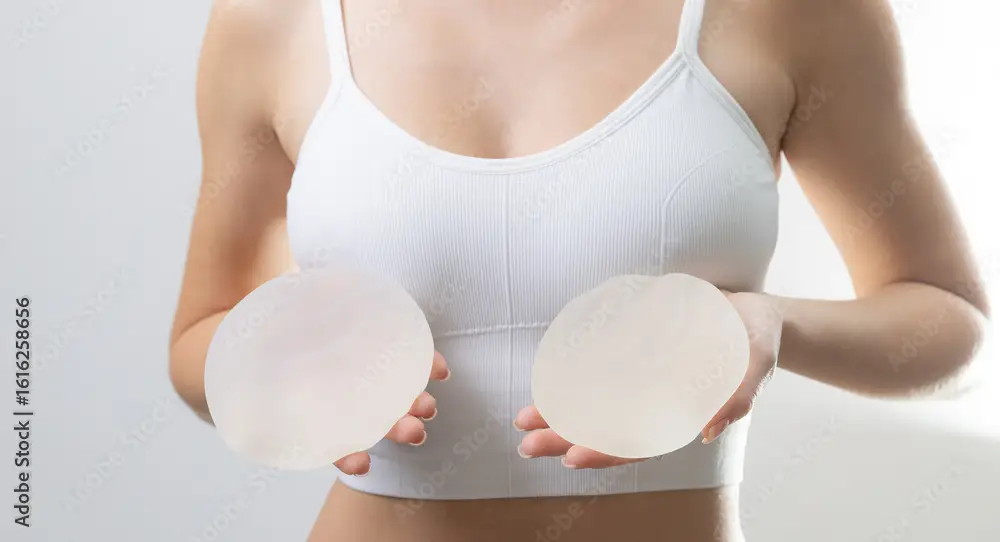
Silicone Gel
Pre-filled cohesive silicone with a soft, tissue-like feel. Lower risk of visible rippling in thin patients.
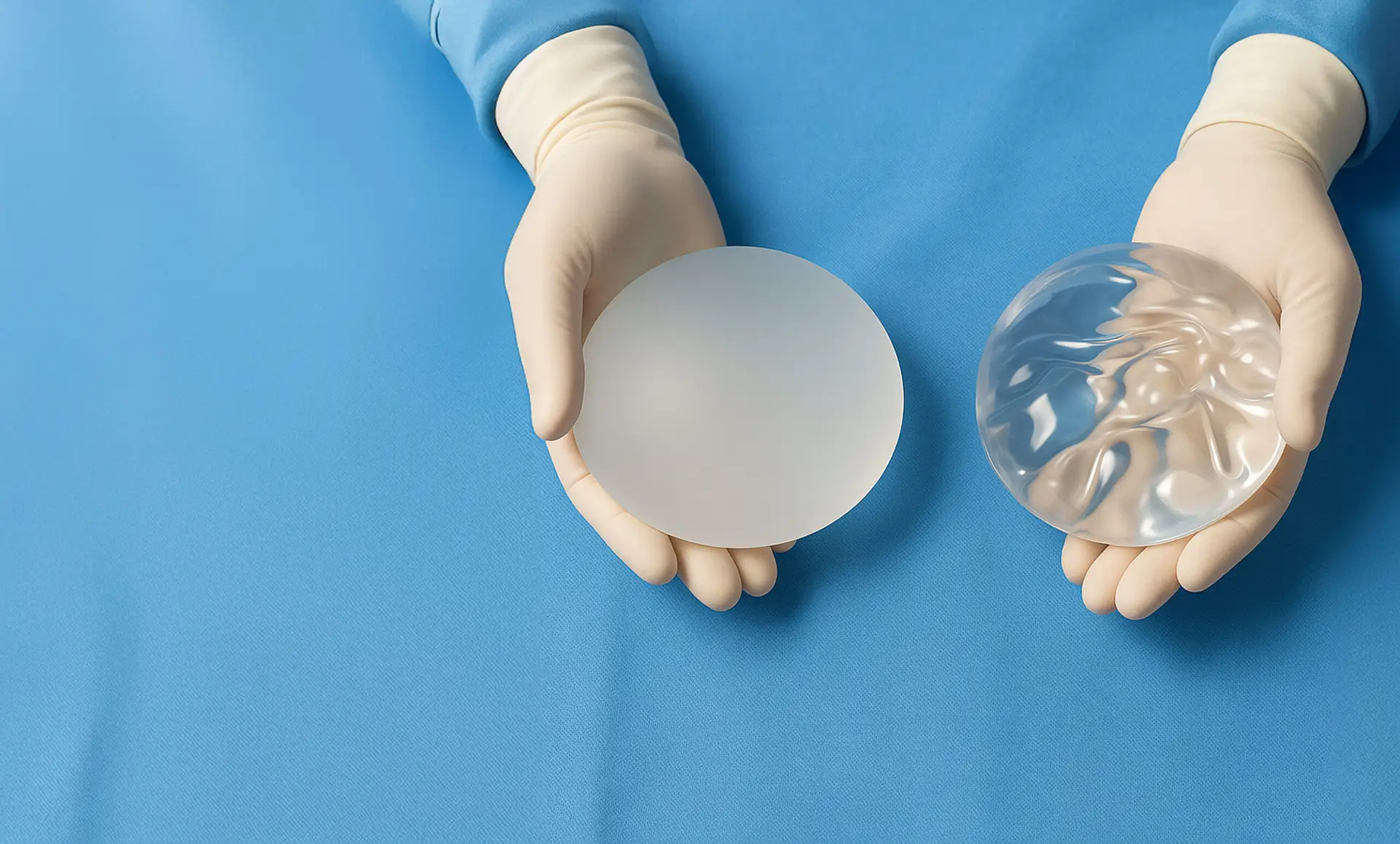
Saline
Sterile salt-water fill placed empty then inflated. Rupture is immediately noticeable; may feel firmer.
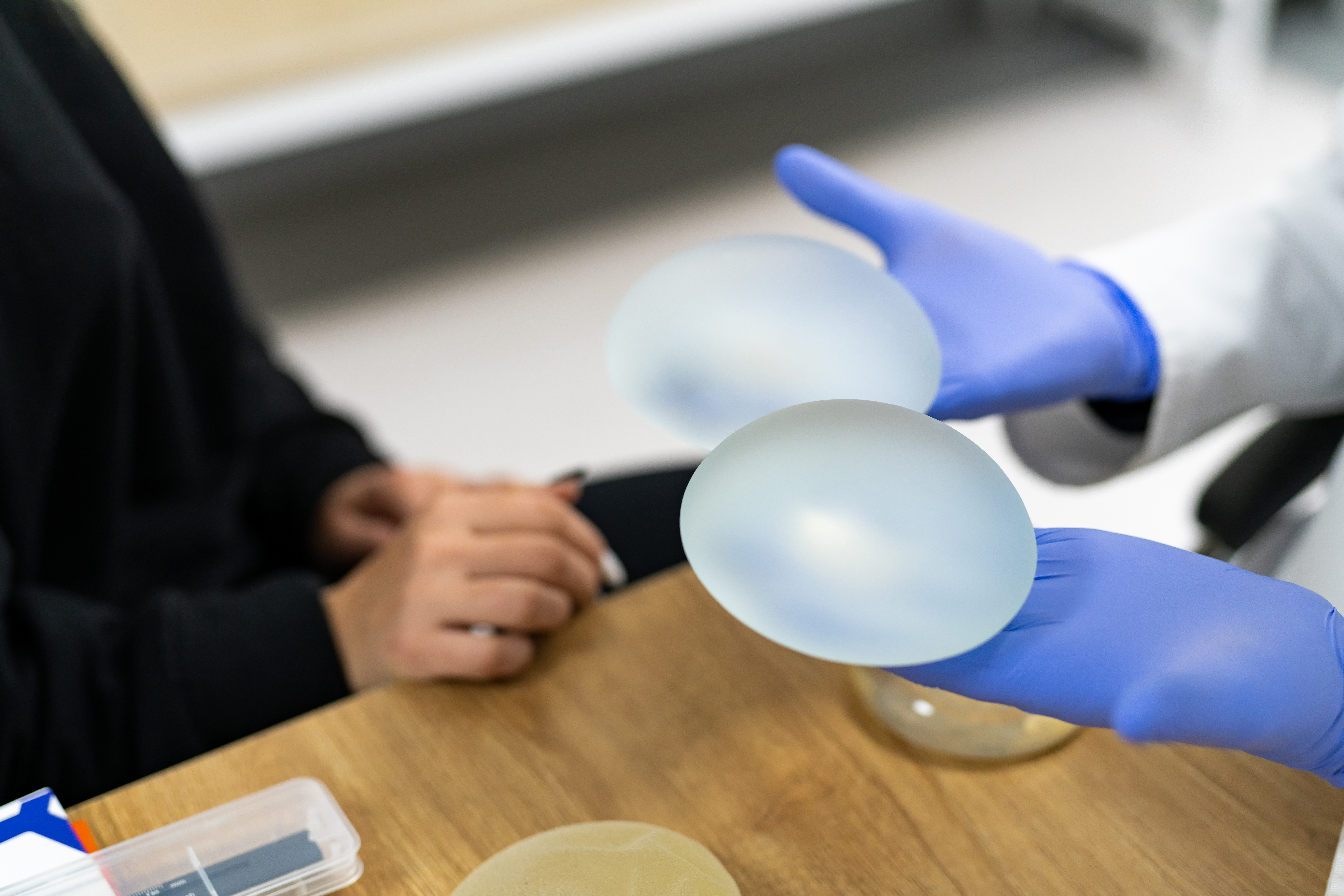
Highly Cohesive Gel
“Form-stable” or “gummy bear” implants maintain shape with a gentle anatomical slope.
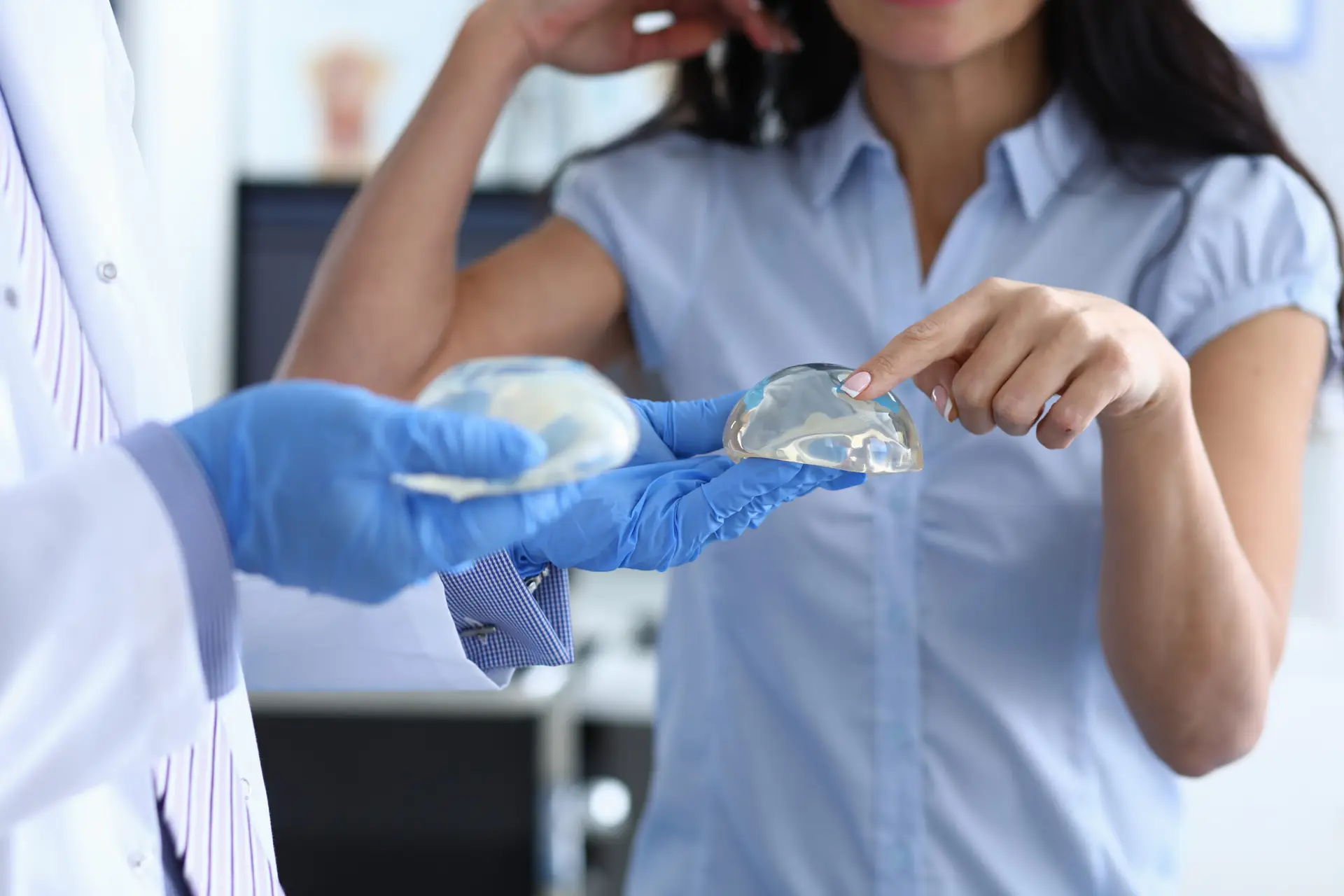
Surface & Profile
Smooth shells reduce friction; textured shells may reduce rotation in select cases. Profile sets projection.
Your surgeon will also evaluate implant volume (cc’s), base diameter, and your tissue’s ability to cover the implant to avoid over-stretching and long-term ptosis (droop).
Precision Matters
Pocket Location
Implant placement is defined by the surgical pocket relative to the pectoralis major and breast parenchyma. The pocket controls upper-pole fullness, implant visibility, and how the breast moves during activity.
1
Submuscular
Implant sits beneath the pectoralis major. Adds coverage and often produces a softer upper slope.
2
Subglandular
Implant sits beneath breast tissue but above muscle. Useful when tissue thickness is adequate.
3
Dual-Plane
Upper implant under muscle, lower portion under tissue. Balances natural movement and fullness.
Incision sites include inframammary (hidden in IMF), periareolar (along areola edge), or transaxillary (underarm). Choice depends on anatomy, implant type, and scar preference.
Is This Right For You?
Ideal Candidates
You may be a strong candidate if you are medically stable, a non-smoker (or able to stop), and seeking proportionate enhancement.
- Hypomastia or loss of volume after pregnancy/weight change
- Breast asymmetry or tubular breast features
- Stable body weight and good skin elasticity
- Realistic expectations about scarring and healing
A pre-operative review includes medication history, bleeding risk assessment, and screening for conditions that may affect anesthesia or wound healing.
Your Experience
The Process
From consultation to final contour, each phase has a clinical purpose.
1
Consultation & Imaging
Measurements, tissue evaluation, and sizing to choose implant volume, base width, and profile.
2
Operative Planning
Incision choice, pocket map, and symmetry goals documented pre-op for accuracy.
3
Surgery (Augmentation Mammoplasty)
Outpatient anesthesia, pocket creation, implant placement, and layered closure.
4
Follow-Up & Scar Care
Surveillance for swelling, seroma, hematoma, and scar maturation.
Recovery & Results
Expect edema (swelling) and tightness early. Implants typically “drop and fluff” as the capsule relaxes and tissues adapt.
○
Week 1
Rest, gentle walks, and a surgical bra. Bruising and pressure are normal.
○○
Week 2-3
Swelling decreases; range of motion improves. Early contour becomes visible.
○○○
Week 4-8+
Resume full activity when cleared. Scar softening and final shape refine for months.
Safety First
Understanding Risks & Monitoring
Common risks include infection, bleeding, delayed wound healing, altered sensation, implant malposition, and the need for revision.
Medical terms you may hear: capsular contracture (tight or thickened scar capsule), seroma (fluid collection), hematoma (blood collection), rippling (visible implant folds), and rupture (implant shell failure). For silicone implants, rupture can be “silent,” so periodic imaging (ultrasound or MRI) may be advised. A rare but important consideration with textured implants is BIA-ALCL (breast implant-associated anaplastic large cell lymphoma); Dr. Herman will review current guidance if relevant.
Questions, Answered
Breast Implant FAQ
How do I choose the right size?
Size selection is based on chest base width, soft-tissue pinch thickness, and implant volume (cc’s). These measurements help prevent over-filling the skin envelope, which can lead to long-term ptosis.
What is capsular contracture?
Your body forms a scar capsule around any implant. If that capsule thickens and tightens, it can feel firm or distort shape. Treatment ranges from observation to capsulectomy (capsule removal) and implant exchange in more advanced cases.
Will implants look natural?
Natural appearance depends on matching implant base diameter and profile to your breast footprint, tissue coverage, and pocket location. A proportional plan avoids excessive upper-pole fullness.
How long do implants last?
Implants are durable but not lifetime devices. Many patients keep implants 10–20+ years. Follow-up exams and imaging help monitor integrity over time.
Can I breastfeed later?
Most patients can. Incision choice and glandular anatomy play a role, and we plan to preserve ductal structures and nipple function whenever possible.
Schedule Your Consultation
Meet with Dr. Herman to review implant types, surgical pockets, and a plan custom-built for your anatomy and goals.
Breast Aesthetic Expertise
Why Choose Dr. Herman
Dr. Herman approaches breast augmentation with a sculptor’s eye and a surgeon’s precision — emphasizing safe volume, symmetry, and long-term tissue support.
- Advanced training in aesthetic & reconstructive breast surgery
- Detail-driven sizing grounded in anatomy and biomechanics
- Careful pocket technique to reduce malposition and contracture risk
Patient Testimonials
Real stories. Real results.
★★★★★
4.8 / 5.0 Overall Rating
Across 1,000+ verified patient experiences.
★★★★★
“I couldn’t be more pleased with the exceptional care I receive at this office. A+ in every way.”
— Verified Patient Review (Jul 1, 2022)
★★★★★
“Dr. Herman is an amazing practitioner. His ability exceeds others. He’s also personable — his people skills match his genius as a plastic surgeon.”
— Verified Patient Review (May 21, 2024)
★★★★★
“Dr. Herman is absolutely the best! He is knowledgeable and professional. He has changed my life forever and made my dream come true. I am very, very pleased with the results! Thank you Dr. H!!!”
— Nicola G. (Plastic Surgery Near You)
★★★★★
“Appointment was on time, all my questions were answered. Staff and doctor were very knowledgeable and pleasant. Got fast results — I’m glad I chose this office.”
— Verified Patient Review (Apr 29, 2025)
★★★★★
“I love the professionalism of the office and Dr. Herman is awesome. I would recommend him to anybody.”
— Verified Patient Review (Apr 10, 2025)
★★★★★
“Dr. Herman is an excellent doctor. His staff is courteous, polite, and knowledgeable. He explains everything thoroughly so you understand, and always answers questions.”
— Verified Patient Review (Jul 2, 2024)
★★★★★
“This man is not only an excellent surgeon — he is an artist. He changed my life and gave me confidence I never knew I had. His work is stellar, and I will continue to go to him for future procedures. His support staff is amazing and professional.”
— Stefanie Franklyn (Plastic Surgery Near You)
★★★★★
“I have gone to Dr. Herman’s office for years. Everyone there is more like family, and they treat you with the utmost care. I would send everyone there to them.”